
Delhi Police Constable’s Actions Spark Outrage at NSUI Protest
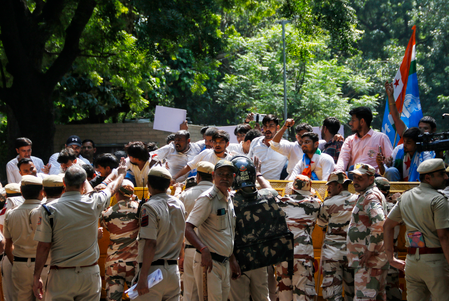
A confrontation between Delhi Police personnel and members of the National Students’ Union of India (NSUI) has triggered fresh debate over police conduct, protesters’ rights, and the handling of demonstrations in India’s capital. Videos circulating on social media have drawn particular attention to the treatment of women protesters during a series of demonstrations connected to demands for the resignation of Chief Election Commissioner Gyanesh Kumar.
The controversy intensified after NSUI accused police personnel of using excessive force against its members. One video reportedly shows a female police officer dragging a woman protester by her hair during a confrontation near Rajiv Chowk Metro Station. The footage has attracted criticism online, although its authenticity and the full circumstances surrounding the incident require careful verification.
The incident comes amid wider demonstrations over alleged electoral irregularities and changes to voter lists. Police have detained several protesters during these gatherings, while NSUI has maintained that its campaign for accountability will continue.
This article examines what happened, why the footage has generated outrage, what NSUI has alleged, and the wider questions surrounding the balance between maintaining public order and protecting the rights and dignity of demonstrators.
Reporting note: Allegations and video-based claims are distinguished from independently established facts. The available reports do not establish that every claim circulating on social media has been verified.
Table of Contents
What Happened During the NSUI Protest in Delhi?
On October 13, 2026, members of NSUI staged a demonstration near Gate 7 of Rajiv Chowk Metro Station in Delhi. The organisation, which is affiliated with the Indian National Congress, was protesting over alleged electoral irregularities and demanding the resignation of Chief Election Commissioner Gyanesh Kumar.
The demonstration took place amid heightened political tensions surrounding the Election Commission and allegations of irregularities in electoral processes. Protesters sought to draw attention to their concerns, while police personnel were deployed to manage the gathering and prevent disruption in the busy Connaught Place area. The situation became tense, and several demonstrators were detained.
Videos shared online showed confrontations between women protesters and female police personnel. These clips quickly became a central part of the public discussion, with attention shifting from the protesters’ political demands to questions about the manner in which police handled the demonstration.
NSUI subsequently accused police personnel of mistreating its women members. The organisation condemned the alleged use of force and called attention to the treatment of protesters during detention. The allegations have added another dimension to an already contentious series of demonstrations in the capital.
However, understanding the incident requires more than watching a short video. Footage may show a particular moment without revealing what happened immediately before or after it. A reliable assessment must consider the complete recordings, statements from those involved, relevant police accounts, and the findings of any investigation.
Why Has the Police Constable’s Conduct Sparked Outrage?
The controversy centres on allegations that police personnel used excessive force while dealing with women participating in the demonstration. A video described in reporting by The Indian Express reportedly shows a female officer dragging a woman protester by her hair during the confrontation. The footage’s authenticity was reported as being under police verification.
Images that appear to show physical force against a woman can provoke strong reactions because they raise questions about dignity, proportionality, and the responsibilities of public officials. Police officers are expected to manage potentially difficult situations while following the law and applicable procedures. Protesters, meanwhile, have a legitimate interest in knowing that any force used against them is justified and proportionate.
The circumstances of an individual encounter remain important. A brief clip alone may not establish whether an officer was responding to an immediate threat, attempting to restrain someone, or acting improperly. Those possibilities should not be treated as equivalent, and none should be assumed without evidence.
Public concern is therefore best understood as a demand for clarity and accountability rather than as proof that every allegation has already been established. If footage supports allegations of misconduct, an impartial investigation should determine who was involved and whether the actions complied with the relevant rules.
Equally, any assessment should consider the safety of police personnel working in crowded demonstrations. Investigations need to examine the full circumstances rather than reaching conclusions based only on the identity of the person involved or the political affiliation of the protesters.
What Was NSUI Protesting Against?
NSUI’s October 13 demonstration was linked to demands for the resignation of Chief Election Commissioner Gyanesh Kumar. The organisation raised concerns about alleged electoral irregularities and what it described as vote theft, placing the protest within a broader political dispute over electoral integrity.
Election-related disputes can become politically sensitive because electoral rolls and election administration are fundamental to the democratic process. Political organisations may organise demonstrations to challenge decisions, demand investigations, or seek the resignation of officials they believe have failed in their responsibilities.
However, allegations of electoral wrongdoing should be distinguished from findings established through official investigations or judicial proceedings. A protest communicates the position of the participants; it does not independently prove the underlying allegations.
In this case, NSUI’s campaign and the police confrontation became intertwined in public discussion. Rather than focusing exclusively on the original political demands, many social media users began discussing the treatment of women demonstrators and the conduct of the officers involved.
The distinction matters because there are two separate questions: whether the protesters’ political allegations are supported by evidence, and whether police actions during the demonstration complied with applicable law and procedure. Each question deserves an independent, evidence-based assessment.
Videos Circulate on Social Media
Social media has played a major role in bringing the confrontation to public attention. Short clips of police-protester encounters can travel rapidly across platforms, attracting comments from political supporters, activists, journalists, and members of the public.
In this case, reporting described footage showing a confrontation between a woman protester and female police personnel. The video reportedly showing a woman being dragged by her hair became a particularly prominent part of the discussion.
Videos can be valuable evidence because they may document actions that would otherwise be difficult to reconstruct. However, a clip’s existence does not automatically establish its authenticity, completeness, location, or context. It is important to establish whether the recording has been edited, when and where it was filmed, and whether additional footage changes the interpretation of the scene.
There is also a risk that unrelated videos may be shared with misleading captions. During periods of political tension, images from different incidents can be presented as though they depict the same event. Readers should therefore check original reporting and verified statements before sharing allegations.
The most responsible approach is to preserve potentially relevant evidence while avoiding unsupported claims about the people shown. An impartial investigation can help determine what the footage establishes and whether further evidence is needed.
NSUI Accuses Police of Using Excessive Force
NSUI has condemned the alleged treatment of its women members and accused police personnel of using excessive force during the demonstration. The organisation’s representatives have argued that the handling of protesters deserves scrutiny and accountability.
The allegations have drawn attention to a broader question: how should police manage a demonstration when tensions rise? Officers may need to enforce lawful restrictions, maintain access to public infrastructure, and prevent clashes. At the same time, those responsibilities do not remove the need to treat people lawfully and humanely.
The assessment of excessive force depends on the circumstances of the encounter, including the level of resistance, any immediate safety threat, the actions taken by officers, and the applicable rules. It cannot be determined solely by the fact that a person was detained or that physical contact occurred.
NSUI’s allegations should therefore be taken seriously enough to warrant a fair examination, without being treated as final findings before the relevant evidence has been assessed.
If misconduct is established, the responsible authorities should take appropriate action in accordance with the law. If particular allegations are not supported by the evidence, that conclusion should also be communicated clearly. Transparency helps protect both the public’s rights and the integrity of investigations.
The Delhi Police and the Challenge of Managing Protests
Delhi Police regularly manages demonstrations involving political organisations, student groups, activists, and members of the public. Such events can present practical challenges, particularly when crowds gather near busy transport hubs, roads, government offices, or locations subject to restrictions.
Police personnel may need to manage crowd movement, prevent dangerous congestion, maintain access for emergency services, and enforce applicable orders. When demonstrators refuse to disperse or attempt to cross barricades, tensions can escalate quickly.
Yet crowd management must remain subject to legal and procedural safeguards. The need to control a gathering does not automatically justify every action taken during its dispersal. Any physical intervention should be assessed in light of the circumstances and the applicable rules.
The current controversy also illustrates the importance of clear communication between police and demonstrators. When organisers understand the restrictions that apply, and police explain their instructions clearly, there may be fewer opportunities for misunderstandings to escalate into confrontations.
Where a confrontation does occur, a transparent review can help establish what happened and identify lessons for future operations. This is important not only for protesters but also for officers, who may face difficult decisions in crowded and unpredictable environments.
Women’s Safety and Dignity During Demonstrations
The allegations involving women protesters have renewed attention to how female demonstrators should be handled during police operations. The concern is not limited to political affiliation. It involves the expectation that people should be treated with dignity, regardless of whether they support the government, oppose it, or have no political affiliation.
Police personnel have responsibilities that include maintaining public order and safeguarding people in their custody. Where procedures require the involvement of female officers, those requirements must be followed. The specific obligations applicable to a particular detention should be assessed under the relevant law and official procedures.
The presence of female officers, however, does not by itself establish that every action during an encounter was appropriate. Likewise, a video showing physical contact does not, without further evidence, establish the complete circumstances or legal character of that contact.
This is why independent scrutiny can be important when credible allegations arise. Investigators should examine the full available footage, statements from witnesses, any relevant medical evidence, and accounts from the officers and protesters involved.
The objective should be to establish the facts, not to prejudge the people involved. If wrongdoing is proven, accountability can reinforce public confidence. If allegations are disproved or require correction, a transparent explanation can help prevent misinformation from spreading.
What Do the Allegations Mean for Protesters’ Rights?
Peaceful assembly is an important democratic right, and public demonstrations provide a way for citizens to express political views and challenge decisions by public authorities. In India, the constitutional framework protects freedom of speech and expression and the right to assemble peacefully, subject to constitutionally permitted restrictions.
These rights do not mean that every demonstration can take place anywhere or without regard to applicable rules. Authorities may impose lawful restrictions to protect public order, safety, and other legitimate interests. The legality of a particular restriction or police response depends on the circumstances and applicable law.
The important distinction is between enforcing a lawful restriction and using force in a manner that exceeds what the situation justifies. A protester’s political position should not determine whether their complaint is examined fairly.
Similarly, police personnel are entitled to protection when carrying out their duties. If protesters assault officers or obstruct lawful police action, those allegations should also be investigated through the proper process.
A balanced approach requires the same basic principles to apply to everyone: evidence, due process, proportionality, and accountability. These principles help ensure that political disagreements do not replace fair assessment of individual conduct.
Why Independent Investigation Matters
When a police encounter becomes controversial, an investigation can establish facts that social media arguments cannot settle. Videos may provide important evidence, but investigators may need to examine original recordings, CCTV footage, witness statements, medical records, and other relevant material.
A proper review should establish the timeline of events, identify the people involved, and assess whether the actions taken complied with the applicable rules. It should also distinguish between conduct that is clearly visible, allegations made by participants, and conclusions that require additional evidence.
Transparency is especially important when allegations concern public officials exercising state authority. A clear explanation of the findings can help the public understand whether misconduct occurred and what steps, if any, will follow.
At the same time, investigations should protect the rights of everyone involved. Public attention does not remove the need for fairness, and unverified claims should not be treated as proof of guilt.
The available reporting identifies controversy surrounding the October 13 NSUI protest and the treatment of women demonstrators. It does not, by itself, establish a final finding of misconduct against a particular constable.
Any definitive account should be updated when reliable information about official findings or further investigative developments becomes available.
The Wider Political Context Behind the Demonstrations
The NSUI protest took place during a period of wider demonstrations in Delhi linked to demands for Chief Election Commissioner Gyanesh Kumar’s resignation. Student groups and other political activists have raised concerns about electoral processes and the revision of voter lists.
The demonstrations have led to repeated confrontations and detentions in the capital. News reports have also documented separate allegations concerning the treatment of protesters and journalists during the broader wave of demonstrations. Those incidents should be distinguished from the specific October 13 confrontation rather than combined into one account.
This wider context helps explain why individual encounters can attract national attention. When political tensions are already high, a video of a confrontation may become a symbol of a much larger dispute about government accountability, police conduct, and democratic rights.
However, political context should not replace evidence about a particular incident. The fact that demonstrations are politically charged does not establish that every police action was improper, just as the need to maintain order does not prove that every use of force was justified.
The most useful reporting keeps these issues connected but separate: the political reasons for the protest, the circumstances of the police response, and the evidence supporting allegations made by either side.
Conclusion
The Delhi Police controversy surrounding the NSUI protest has raised important questions about police conduct, the treatment of women demonstrators, and the handling of politically sensitive gatherings. Videos circulating online, including footage reportedly showing a woman being dragged by her hair, have prompted criticism and renewed calls for accountability.
The demonstration took place on October 13, 2026, near Rajiv Chowk Metro Station, as NSUI members protested over alleged electoral irregularities and demanded the resignation of Chief Election Commissioner Gyanesh Kumar. Several protesters were detained, and the confrontation quickly became a wider public debate about the use of force during demonstrations.
The allegations deserve careful examination, but conclusions should depend on verified evidence rather than viral captions or political assumptions. A fair investigation should establish what happened, determine whether the actions complied with the law, and ensure appropriate accountability if misconduct is proven.
Ultimately, maintaining public order and protecting citizens’ rights are not opposing goals. Both are essential to a democratic society. Transparent investigations, responsible reporting, and respect for due process offer the strongest path toward understanding the incident and preventing similar controversies in the future.
Frequently Asked Questions
1. What happened during the NSUI protest in Delhi?
On October 13, 2026, NSUI members demonstrated near Rajiv Chowk Metro Station, demanding the resignation of Chief Election Commissioner Gyanesh Kumar over alleged electoral irregularities. The gathering turned tense, several demonstrators were detained, and videos of confrontations between women protesters and police personnel circulated online.
2. Why is the Delhi Police constable facing criticism?
Online criticism centres on footage reportedly showing a female police officer dragging a woman protester by her hair. NSUI accused police personnel of using excessive force. The footage and the full circumstances should be verified before definitive conclusions are drawn.
3. What was NSUI demanding during the demonstration?
NSUI was protesting over alleged electoral irregularities and demanding Chief Election Commissioner Gyanesh Kumar’s resignation. Its campaign included allegations concerning vote theft and the conduct of electoral processes. These are the organisation’s claims, not findings established merely by the demonstration.
4. Has police misconduct been conclusively established?
The reports cited here describe allegations and video footage that attracted public attention. They do not establish a final finding of misconduct against a specific constable in the October 13 incident. A definitive conclusion requires verified evidence and the outcome of any relevant investigation.
5. Why has the incident attracted so much attention?
The incident combines a politically sensitive protest with concerns about the treatment of women demonstrators and the use of force by public officials. Social media has amplified the discussion, while the wider dispute over electoral integrity has added to public interest. The controversy highlights the importance of transparent investigations and accurate reporting.
More Info About Kpopbio